20 Questions You Must Always ASK ABOUT Self Propelled Bariatric Wheelchair Before Purchasing It


Self Propelled Bariatric Wheelchair
A bariatric wheelchair can increase independence, comfort, and security for people who are heavier than a basic chair. Typically, these chairs are advised by an occupational or physical therapist with a specialized credential called an ATP (Assistive Technology Professional).
These wheelchairs have actually reinforced frames that can accommodate much heavier individuals. This kind of chair can also help in reducing the danger of pressure injuries.
Seat-to-floor height
The seat-to-floor height of a self propelled bariatric wheelchair is vital for the security and convenience of the person using it. The ideal height will decrease the threat of pressure injuries and make sure that the individual is able to engage in activities of daily living. To take this measurement, the wheelchair user must sit in their chair and put their feet on the footrests. Then, they need to move the chair backwards and forward to see how well their feet remain on the footrests. They must also look at the height of their knees and the distance between their knees. This measurement will assist them discover the best size for their chair.
In addition to seat-to-floor height, other dimensions of a bariatric wheelchair that are very important include seat width, back height, and seat depth. The proper measurements will prevent positioning concerns such as skin shearing, pelvic tilting, and unsteady postures. Seats that are too deep can cause forward weight shift and instability, while seats that are too narrow cause skin shearing. Finally, a seat that is too low can result in bad trunk stability.
A secondary factor to consider when picking a bariatric wheelchair is the capability to satisfy the person's specialized requirements in regards to rearranging and pressure redistribution. Wheelchairs with seating systems like Broda's Comfort Tension Seating supply pressure management that accommodates a wide variety of bariatric body shapes, minimizing the danger of pressure ulcers.
Another location of issue for bariatric wheelchair users is the problem of moving in and out of the wheelchair. Wheelchairs with padded raising leg rests allow caretakers to easily lift the individual in and out of their wheelchair. This removes the need to stretch or squat, which can increase the danger of injury and reduce caretaker complete satisfaction.
Eventually, it's best to have a seating evaluation finished by a competent health care specialist. This might be an occupational therapist, physiotherapist, or an assistive innovation professional (ATP). My Mobility Scooters of the seating assessment will act as evidence of medical need for insurance purposes. It will also make sure that the wheelchair is a great fit for the individual and will permit them to accomplish their mobility objectives. To begin, download our complimentary Bariatric Seating Assessment Form from the Broda site.
Weight capacity
The weight capacity of a self propelled bariatric wheelchair is an important aspect to consider when choosing a wheelchair for heavier people. These chairs are often developed to hold up against higher body weights than traditional wheelchairs and generally included bigger seat measurements. They also have actually reinforced frames and parts to offer greater stability and toughness.
To guarantee that the weight capacity of a wheelchair is suitable for its designated use, it's an excellent idea to seek advice from a mobility professional or health care company. They can assess your specific needs and advise a chair that will best satisfy them. Furthermore, they can assist you select the best accessories to improve convenience and assistance.
For instance, including a back cane or specifically developed placing belts can help provide additional stability and security for individuals who invest extended periods of time in their wheelchairs. In addition, adding a bariatric tri-foam cushion can supply sophisticated pressure relief to help prevent the development of pressure ulcers.
When searching for a bariatric wheelchair, it's vital to precisely determine your height, seat-to-floor, and hip-to-heel ranges to guarantee that the chair is the appropriate size. It's also practical to test drive the chair to see how comfy it is.
A bariatric wheelchair is a great choice for overweight and taller people who require a steady and resilient mode of transportation. They're normally more spacious than standard wheelchairs, making them much easier to steer and suitable for a wider series of users. They can also be easily customized to suit private requirements.
Regardless of their bigger frame sizes, bariatric wheelchairs can be folded down to make them simpler to store and transport. They're also generally lighter than aluminum wheelchairs, making them easier to lift and move around. They can also be acquired with a range of accessories to tailor them for your special requirements, consisting of power placing systems and iLevel seating. They can even be fitted with attendant brakes for included security and benefit.
Wheels
This bariatric wheelchair is a self-propelled design, implying that the occupant of the chair can move it using the wheels at the back. It has a practical handle next to the tyres for the occupant to utilize to turn the wheels, making it much easier for them to navigate the chair on their own.
Bariatric wheelchairs also have bigger wheels than standard wheelchairs, which make them more stable for much heavier users. They are also normally more long lasting than their lighter counterparts. Compared to basic wheelchairs, bariatric wheelchairs are more costly, however they might be covered by Medi-Cal if you have a certifying medical condition.
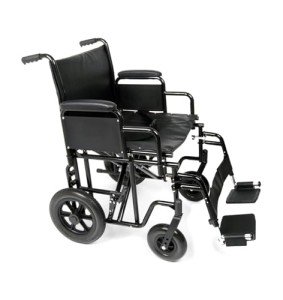
With an optimum weight capacity of 317kg and double-reinforced upholstery, this heavy-duty wheelchair is ideal for those with higher body weights. Its frame is made from chrome-plated steel for maximum sturdiness and includes moulded detachable desk arms, swing away removable foot plates, and adjustable raising leg rests left and right. This wheelchair also has 60cm self moving leak evidence rear tires and front tyres and a padded seat sling that is comfy for long-term usage. Its compact folding frame makes it simple to transport and shop. Appropriate for both indoor and outdoor use. For additional comfort, this wheelchair can be fitted with a variety of accessories consisting of power placing systems and iLevel seating.
Seat width
Unlike standard wheelchairs, which have smaller chairs, bariatric chairs are developed to support larger users. Their frames are made from stronger products and have wider armrests to accommodate bigger users. They also have more large seating and bigger wheels. This makes them appropriate for everyday indoor and outdoor usage. However, their bigger size means they might be more difficult to maneuver.
The KM-BT10 is a sturdy bariatric self propelled wheelchair with a weight capacity of approximately 315kg (39 stone) and a seat width of 22" in 2" increments. The wheelchair has a robust and collapsible frame that is simple to stow and raise, energy saving self propel system, attendant and user brakes and a special swing away detachable footrest style.
The wheelchair is fitted with strong 24" rear tyres and leak evidence front tyres for exceptional traction and control. It has a strong nylon seat with padded raising leg rests that are adjustable left and right for comfort. It can be bought with or without the leg rests, depending on the user's requirements.